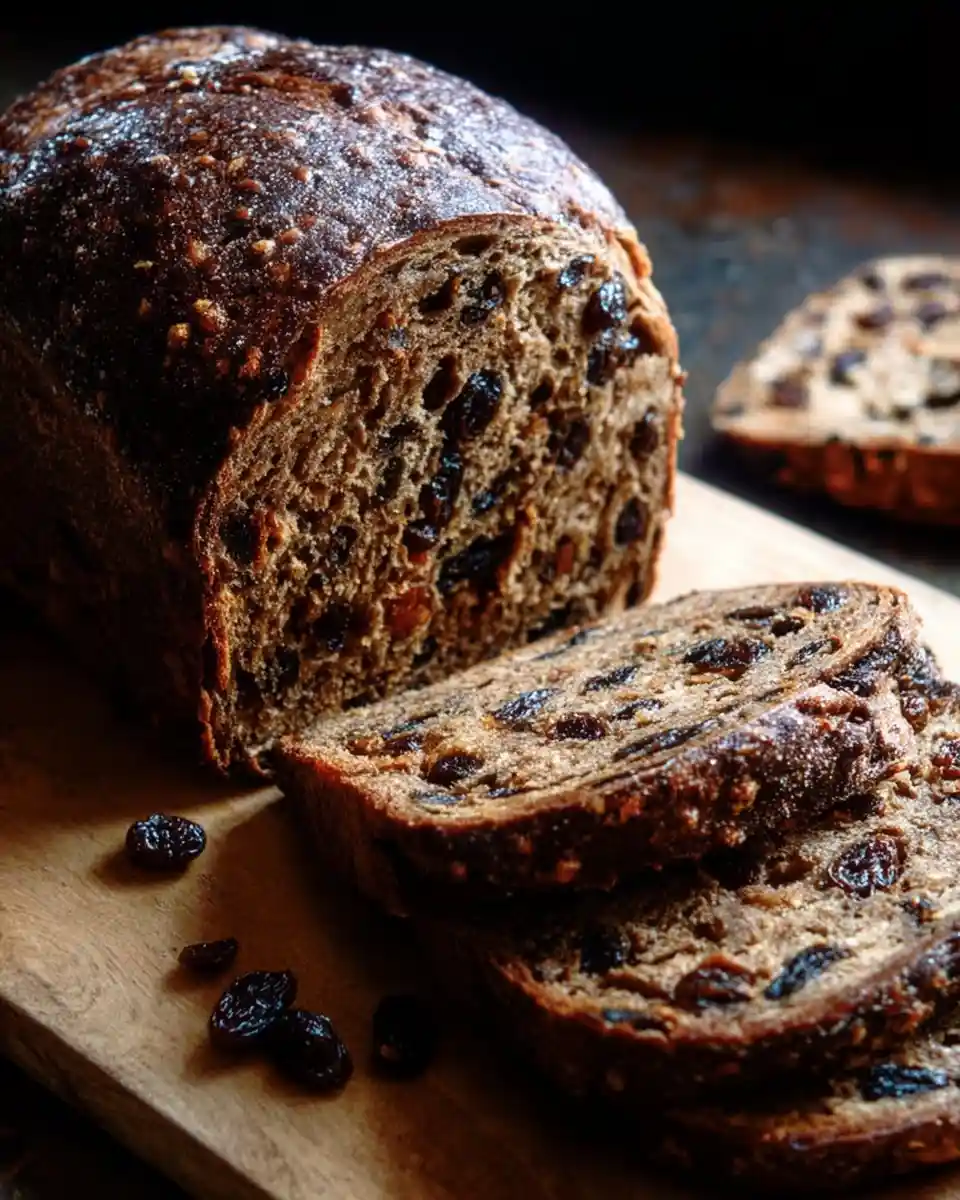
Ingredients
Equipment
Method
- In a small saucepan, bring 1/4 cup of water to a simmer. Add the raisins, remove from heat, cover, and let them plump for at least 10 minutes while you prepare the dough. Drain well before adding to the dough.
- In a large mixing bowl, combine 1/2 cup warm water, yeast, and granulated sugar. Let sit for 5 minutes until foamy. Stir in 1/2 cup dark rye flour until combined. Cover with plastic wrap and let sit at room temperature for 30 minutes to create a bubbly, active starter.
- To the activated starter, add 1 1/2 cups warm water, molasses, cocoa powder, espresso powder (if using), and salt. Stir well to combine. Gradually add the remaining 3 cups dark rye flour and 2 cups of the all-purpose flour, mixing until a shaggy dough forms.
- Turn the dough out onto a lightly floured surface (using the remaining 1/2 cup all-purpose flour as needed) or use a stand mixer with a dough hook. Knead for 8-10 minutes (10-12 minutes by hand) until the dough is smooth, elastic, and slightly tacky. This will be a dense, heavy dough due to the rye flour.
- Flatten the dough slightly and spread the well-drained raisins over it. Fold the dough over and knead gently for 1-2 minutes until the raisins are evenly distributed throughout the dough.
- Lightly grease the large mixing bowl. Place the dough in the bowl, turning once to coat. Cover with plastic wrap or a clean kitchen towel and let rise in a warm place for 2 to 2.5 hours, or until doubled in size.
- Gently punch down the dough to release air. Turn it out onto a lightly floured surface. Shape the dough into a tight loaf that fits a 9x5 inch loaf pan. To do this, flatten the dough into a rectangle, fold the longer sides towards the center, then roll it tightly from one end to the other, pinching the seam closed at the bottom.
- Lightly grease the 9x5 inch loaf pan. Place the shaped dough into the prepared pan. Cover loosely with plastic wrap or a clean kitchen towel and let rise in a warm place for 1 to 1.5 hours, or until it has nearly doubled and crested over the top of the pan.
- Preheat your oven to 375°F (190°C) during the last 20 minutes of the second rise. Bake the bread for 45-55 minutes, or until the internal temperature reaches 200-210°F (93-99°C) and the crust is dark brown and firm. If the crust is browning too quickly, you can loosely tent it with foil during the last 15-20 minutes.
- Once baked, immediately remove the bread from the loaf pan and transfer it to a wire cooling rack. Let it cool completely for at least 2 hours before slicing. Slicing warm pumpernickel bread can make it gummy.
Notes
For an even darker color and richer flavor, you can add 1 tablespoon of caraway seeds to the dough along with the flour. This bread is excellent toasted and served with cream cheese, butter, or jam. It also makes a fantastic base for sandwiches. Store cooled bread in an airtight container or bread bag at room temperature for up to 4-5 days, or freeze for up to 3 months. Rye flour can make dough sticky; avoid adding too much extra flour during kneading as it can make the bread dry. A sticky dough is normal for rye dough.